


Traveling with your PAP medical device
Travel is stressful enough without worrying about your CPAP, BiPAP or APAP. But bringing it along is worth the extra planning as it keeps your treatment on track and helps you get good sleep while you're away. Here are some tips to make the process easier.
1. Carry a copy of your prescription
If you're traveling for several days, or especially out of the country, keep a copy of your PAP prescription in your wallet or bag. Although you will rarely need a copy of your prescription for travel within the US, carrying a prescription for international travel can help avoid paying import taxes by proving that the device is for personal use. Include your machine, mask, tubing, filters, headgear, and humidifier in the prescription. If your luggage is lost or stolen, this makes it much easier to replace any part of your setup. Therefore, attaching a luggage tag with your contact information on your CPAP case can be useful.
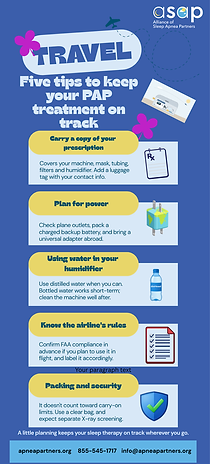
2. Plan for power
-
On the plane: Check ahead of time whether your flight has electrical outlets, and what type they are.
-
Backup power: Bring a backup power supply in case outlets aren't available or the power goes out. Portable PAP batteries are available from durable medical equipment vendors or online. Charge it fully before you leave, and keep it charged throughout your trip.
-
International travel: Consider a universal power adapter, since outlets may use a different voltage or plug style than yours. Check in advance which adapter works where you're headed.
3. Using water in your humidifier
PAP humidifiers are designed for distilled water to prevent buildup of mineral deposits. If distilled water isn't available, bottled water can be used for a short time. Clean your machine thoroughly as soon as you can afterward to prevent mineral deposits from building up.
4. Know the airline's rules
PAP machines count as medical equipment, so check your airline's policy before you fly.
-
If you plan to use your PAP during the flight, most airlines require advance verification that your model meets FAA standards. For example, United Airlines asks for confirmation 48 hours before departure.
-
Be ready to share details about your device if asked.
-
It can help to label your machine as FAA-compliant and approved for in-flight use.
5. Packing and security
-
Most airlines don't count medical equipment toward your carry-on limit, so pack your PAP as a carry-on whenever possible.
-
According to Transportation Security Administration (TSA) guidelines, CPAP, BiPAP and APAPs as well as facemasks and tubing may remain in their carrying case for X-ray screening. But these may be required to be removed from the carry-on.
-
At security, your PAP machine may be removed from its case and run through the X-ray separately; hoses, headgear, and masks usually stay in your bag.
-
Pack a clear plastic bag for your machine so it doesn't touch unsanitary bins or conveyor belts.
-
If a security officer needs to inspect your PAP closely, you can ask them to use a fresh pair of gloves and a new swab.
Traveling with your CPAP is easy with little preplanning and following the above tips. Finally don’t forget to pack your favorite wipes to keep your equipment clean!
Additional Resources:
Tips for Traveling With Your CPAP Device—Even by Air, April 30, 2025