


Understanding PAP Devices: CPAP, APAP, Bi-Level, and ASV
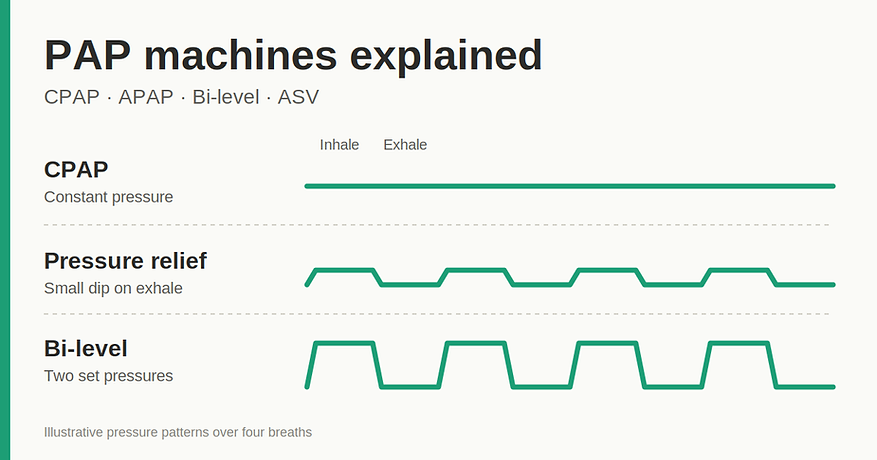
The term “CPAP” is often used generically to refer to any of several devices that deliver Positive Airway Pressure (PAP) therapy for sleep apnea, a type of sleep-disordered breathing. Strictly speaking, though, CPAP is just one type of device. Here is a brief description of the main types, in rising order of complexity and sophistication.
CPAP (Continuous Positive Airway Pressure)
This is the most basic device and the first to be developed. It delivers a single, constant pressure all night, usually adjustable between 4 and 20 cm H2O. Pressure needs can vary somewhat with sleep stage and body position, but for many people with uncomplicated obstructive sleep apnea a single well-chosen pressure works very well. Many CPAP devices also offer expiratory pressure relief (marketed as EPR, C-Flex, and similar names), which briefly lowers the pressure as you exhale to make breathing out feel more natural. The reduction is small, typically 1 to 3 cm H2O.
APAP (Auto-Adjusting Positive Airway Pressure)
The “A” stands for “auto” or “automatically adjusting.” An APAP device works within a pressure range set by your clinician and continuously monitors your breathing for signs of trouble such as snoring, airflow limitation, and apneas or hypopneas. It raises pressure when it detects these events and lowers it when they clear. It reacts to what it detects rather than predicting what you’ll need. This can help people whose needs change with sleep stage, body position, weight change, or alcohol use, and it is often used to help determine the right pressure in the first place. Studies generally show similar effectiveness to fixed CPAP for uncomplicated obstructive sleep apnea, with at most a small advantage in comfort or usage for some patients.
Clinicians often set a narrower range than the full 4 to 20 cm H2O the device is capable of. A narrower range can prevent unnecessarily high pressures, which may cause swallowed air, discomfort, or awakenings. It can also limit the chance of central apneas appearing at higher pressures. Some manufacturers offer models with algorithms tuned for women, who often show more subtle airflow limitation and fewer classic apneas, though independent evidence that these models improve outcomes is still limited. Most APAP devices also include expiratory pressure relief. An APAP set to a single fixed pressure works essentially as a CPAP.
Bi-Level (Bilevel PAP)
Bi-level devices deliver a higher pressure when you breathe in and a lower one when you breathe out, with the gap between the two set by your clinician. (“BiPAP” is a Philips trademark; “bilevel” is the generic term.) They can also reach higher pressures, often up to about 25 cm H2O. Bi-level is typically prescribed for people who need high pressures (generally above about 15 cm H2O), who cannot tolerate CPAP or APAP, or who have conditions that affect breathing beyond the airway itself, such as obesity hypoventilation syndrome, COPD, or neuromuscular and chest-wall disorders. Some models also include a backup breath rate for people who don’t reliably trigger breaths on their own. The larger pressure difference is what these conditions require, and pressure relief on CPAP or APAP doesn’t substitute for it.
ASV (Adaptive Servo-Ventilation)
ASV is a more specialized device that continuously adjusts pressure support breath by breath to stabilize irregular breathing patterns. It is used for certain patients with central sleep apnea or Cheyne-Stokes respiration, and sometimes for treatment-emergent central sleep apnea (often called “complex” sleep apnea) that persists after other therapy has been tried. Complex sleep apnea often resolves with time on CPAP, so ASV is generally not a first step.
If You’re “Fighting the Mask”
Waking repeatedly with the mask off has many possible causes, and the device type is often not the main one. Common culprits include poor mask fit or leaks, dry nose or mouth (humidification often helps), claustrophobia, discomfort with the pressure, and removing the mask unconsciously in your sleep. A ramp feature (which starts at a lower pressure and rises gradually), a different mask style, or better fit may solve the problem. Talk with your sleep clinician or equipment provider before changing devices or settings. Most modern devices record usage, leak, and residual AHI, and your clinician can use that data to fine-tune your therapy.
Prescriptions, Settings, and Coverage
PAP devices and settings require a prescription, and you shouldn’t change your pressure range on your own or switch devices without guidance. Insurance coverage often depends on documented use. Medicare, for example, generally requires use of at least 4 hours per night on 70% of nights during a consecutive 30-day period within the first 90 days. Coverage for bi-level devices often requires documentation that CPAP was tried and was not effective. Requirements vary by insurer, so check with your provider.
A note on terms: AHI (apnea-hypopnea index) is the number of breathing pauses and partial blockages per hour of sleep and is commonly used to gauge severity and to check how well treatment is working. REM is the stage of sleep associated with vivid dreaming, when the airway muscles are most relaxed. Pressure is measured in centimeters of water (cm H2O).
Important safety note: ASV should not be used in people with symptomatic heart failure with reduced ejection fraction (LVEF of 45% or less) and predominantly central sleep apnea. The SERVE-HF trial found an increased risk of cardiovascular death in this group.